

RAMP Alumni Spotlight: Harper Thomas of Performance Medical Technologies
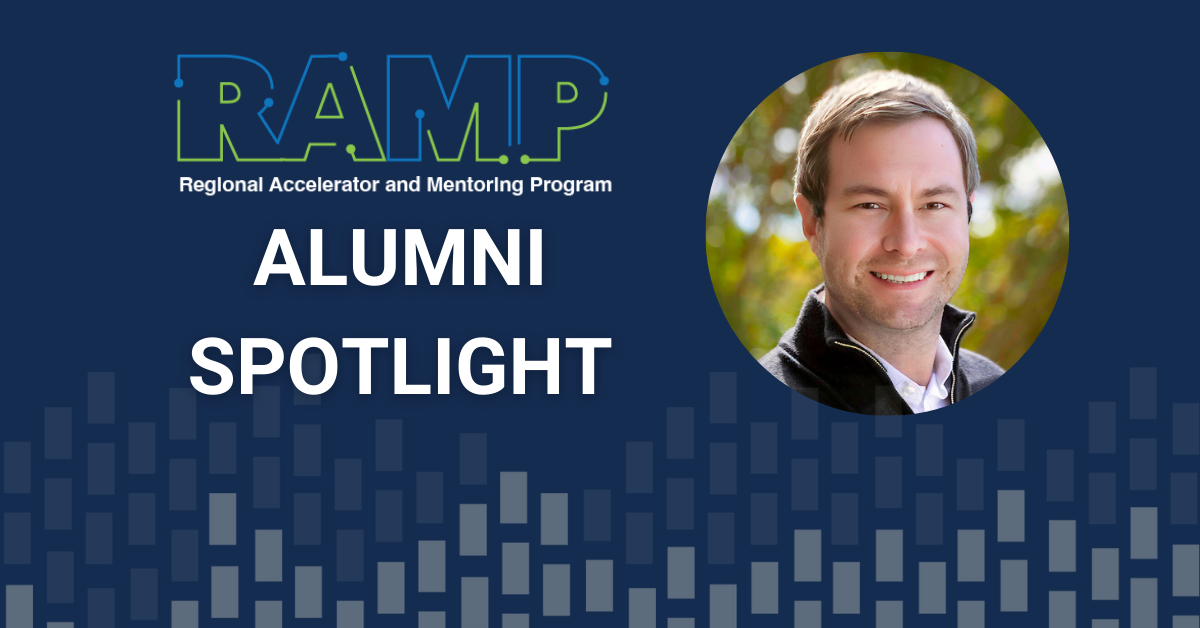
Performance Medical Technologies CEO Harper Thomas has always had a passion for entrepreneurship. Originally from Richmond, VA, Harper attended boarding school in Orange, VA before studying business administration at the College of Charleston in South Carolina where he began his career.
After holding senior leadership positions with several high growth startup tech companies, Harper was recruited by one of the leading performance medicine/concierge physicians in the country, whose patients included professional athletes and Fortune 500 executives. There, he led the installation of over 60 intravenous nutrient therapy clinics from New York to California.
In the course of his work in performance medicine, Harper noticed that one therapy in particular might have clinical application for neurodegenerative disease treatment. He was introduced to Kurt Wassenaar, a seasoned healthcare technology entrepreneur with an extensive background in clinical data science, and was offered an opportunity to move to Charlottesville, Virginia to focus on this opportunity. They quickly formed a strong partnership and together founded Performance Medical Technologies (PMT) a company dedicated to advancing innovative therapies and for neurodegenerative diseases.
Harper took PMT through the RAMP In Residence accelerator in the Fall of 2023. We had the chance to catch up with him to hear his reflections on life science entrepreneurship, how RAMP impacted his commercialization journey, and the plans he has for the future of PMT.
Our Interview with Harper Thomas
Tell us more about the origin story of your company. What inspired you?
I was introduced to an increasingly popular nutraceutical during my work in performance medicine. At the time, I was working primarily with patients seeking athletic and cognitive optimization. After taking a deeper dive on the science behind the benefits of this therapy, I discovered that the clinical potential of this nutraceutical had never been rigorously studied for neurodegenerative disease. I was convinced that this scientific gap needed translational research, especially for patients facing conditions like Parkinson’s disease.
Through mutual friends in Charlottesville, I met Kurt—who had a successful track record of building, scaling, and exiting biotech companies—and we discovered a shared interest in deep mitochondrial biology, neurodegeneration, and systems-level restoration. We also had deeply personal connections to Parkinson’s and related neurodegenerative diseases. We wanted to see meaningful progress in treatment and we saw the potential in this nutraceutical. So, we founded Performance Medical Technologies to develop and clinically validate a new therapeutic approach for early-stage Parkinson’s disease.
After sending interview requests via direct mail to over 400 physicians across multiple specialties including integrative medicine, neurology, internal medicine, and family medicine, I connected with an integrative neurologist who had recently treated Parkinson’s patients with remarkable outcomes. We jumped on a plane and visited the clinic where this nutraceutical compound was being used for patients with both early and advanced Parkinson’s symptoms.
We witnessed people who could barely walk one day regain the ability to stand, move independently, and lose their tremors within days. One patient was flipping pancakes and dancing in the kitchen after 5 days of treatment, and this was something we could not unsee. That experience solidified our commitment to pursuing formal scientific and regulatory validation which is the only way the neurology community will consider offering this therapy to the millions of patients afflicted with this devastating condition.
How did you choose RAMP as your accelerator?
We joined the RAMP accelerator in Roanoke because it offered a focused health and life sciences track that did not yet exist in Charlottesville. At a critical early stage of development, PMT needed an accelerator that understood the scientific, regulatory, and commercialization challenges inherent to therapeutics and data-driven healthcare.
RAMP provided access to mentors, resources, and expertise tailored to life sciences. Because of that, PMT was able to build more rigor into our strategy, sharpen our clinical and regulatory path, and connect with a community positioned to support healthcare innovation.
Prior to RAMP, we engaged the Central Virginia Small Business Development Center (SBDC) and joined the ICAP Program, a statewide initiative designed to help technology founders validate markets, refine value propositions, and define commercialization pathways. It was a great experience and prep for RAMP.
What has it meant for your company to have participated in RAMP?
RAMP brought rigor to customer discovery. ICAP felt like earning a bachelor’s in customer discovery and RAMP was the PhD. Our mentors worked with us to analyze recorded conversations with Parkinson’s patients and neurologists. That analysis gave the team a clearer view of diagnostic timelines, treatment paths, and pain points in early-stage care.
Who are some Roanoke Blacksburg mentors that have impacted you?
First and foremost, Mike Abbott. Mike challenged PMT to focus on the problem rather than the solution, which proved invaluable in removing bias ahead of patient and physician interviews. He helped the team refine its approach to customer discovery by offering guidance on how to engage neurologists and caregivers, how to frame questions without leading, and how to listen for patterns rather than confirmation. Mike’s mentorship laid the foundation for PMT’s early understanding of the Parkinson’s journey and the unmet needs within it.
Francis Farrell served as PMT’s primary mentor and opened critical doors within Carilion’s clinical network. He facilitated introductions to neurologists, researchers, and clinical collaborators both within and adjacent to the Carilion ecosystem. As Carilion’s Director of Research and Development for clinical trials, Francis offered strategic insight into trial design, regulatory expectations, and physician decision-making. His perspective helped PMT better anticipate the clinical and regulatory realities that would ultimately shape the company’s development path.
Following the program, Marty Rosendale and John Hagy continued to mentor PMT as Exit RAMP advisors. Both provided highly constructive feedback on PMT’s pitch, communication strategy, and framing of clinical value propositions to investors and strategic partners. Their support helped PMT translate a complex scientific and regulatory message into a coherent and compelling narrative for capital formation and stakeholder engagement.
Greg Fisher and James Ramey from VTC, Sarah Spotswood, Jess Edwards, Jessie Dunn, and the wonderful RBTC team were phenomenally helpful to PMT as well and deserve recognition.
What is one obstacle in the founding of your company that you’re most proud of overcoming?
One of the obstacles we are most proud of overcoming was gaining support for PMT’s clinical trial program. Recently PMT entered into an agreement with Dr. Alfonso Fasano, a globally recognized leader in Parkinson’s Disease and Movement Disorders, known for his work in neuromodulation and clinical trial innovation. His support provided essential validation of our scientific thesis and gave PMT a path toward first-in-human studies.
What piece of advice would you give early-stage tech/biotech entrepreneurs?
Invest deeply in customer discovery. RAMP pushed us to interview neurologists, patients, researchers, and caregivers, and to analyze those conversations for patterns instead of confirmation. That discipline shaped our clinical strategy, clarified unmet need, and challenged us to think like the people we aim to serve.
Anything else you’d like us to know about PMT accomplishments?
Parkinson’s affects a global patient population, making PMT’s therapeutic inherently international rather than local or regional. In 2025, PMT won competitive grant funding in Italy to advance preclinical studies, formalized a global corporate structure to support regulatory work in both the US and EU, and forged a partnership with Humanitas to take our therapy directly into Phase 2 clinical trials under EMA guidance. None of that happens without a team of people who are deeply committed to changing how Parkinson’s is treated.
Apply for RAMP In Residence
Have a technology or life science company that’s ready to go to the next level? Applications for RAMP In Residence are open until January 25, 2026. Apply today.